Https Check provides a quick overview of why a permanent 301 redirect from http:// to https:// is essential for protecting user credentials and preserving search‑engine value. When a browser negotiates TLS 1.2 or TLS 1.3, the padlock icon confirms encryption, but many sites still serve both protocols. If the insecure address is not redirected, visitors may submit passwords or credit‑card numbers over an open channel and search engines will not credit the site for full HTTPS adoption. Configuring the server to forward every HTTP request ensures that bookmarked URLs, third‑party links, and automated crawlers all benefit from encryption.
Users can validate redirect chains, response headers, and certificate health with a range of free online tools. httpstatus.io accepts up to 500 URLs, records each HTTP status (301, 302, 404), all response headers and round‑trip time, and lets users simulate Googlebot, iPhone Safari or a custom User‑Agent. WebConfs.com displays the full header set—including Strict‑Transport‑Security and Content‑Security‑Policy—and offers a bookmarklet for instant inspection. Jitbit’s SSL‑check crawls up to 400 pages, flagging mixed‑content links so browsers won’t block scripts. SSL Shopper, Qualys SSL Labs, and IONOS each test the public certificate chain, protocol support, cipher suites and known vulnerabilities, delivering grades or actionable remediation steps. Together these services help administrators secure every request, confirm proper redirects, and maintain a trustworthy HTTPS presence.
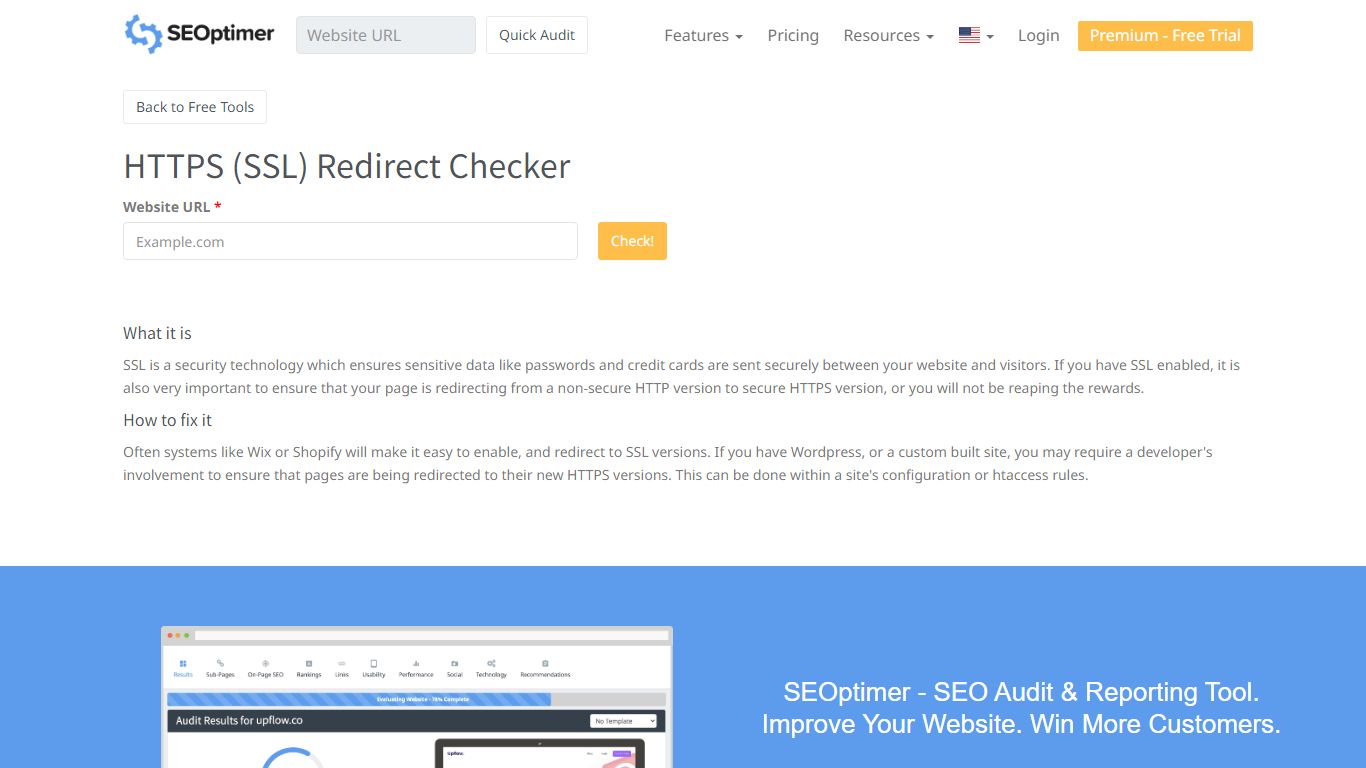
HTTPS (SSL) Redirect Checker – SEOptimer Overview
Secure Sockets Layer (SSL), now commonly referred to as Transport Layer Security (TLS), encrypts data that travels between a web server and a visitor’s browser. When a user submits a password, credit‑card number, or any personal identifier, the information is transformed into ciphertext that can only be deciphered by the intended destination. Modern browsers display a padlock icon when a site successfully negotiates TLS 1.2 or TLS 1.3, confirming that the connection is encrypted. However, many sites still host both an insecure http:// version and a secure https:// version. If the insecure address is not permanently redirected (using a 301 status code) to the encrypted one, visitors may inadvertently transmit data over an open channel, and search engines will not award the SEO benefits associated with full HTTPS adoption. Correcting this requires configuring the web server to forward every HTTP request to its HTTPS counterpart, ensuring that all traffic, including bookmarked URLs and third‑party links, benefits from encryption.
Bulk URL HTTP Status Code, Header & Redirect Checker – httpstatus.io
The httpstatus.io platform lets users submit a list of up to 500 URLs and returns a complete redirect trace for each request. For every step in the chain, the tool records the HTTP status code (e.g., 301, 302, 404), all response headers such as Server, Content-Type, and Cache-Control, the size of the response body in bytes, and the round‑trip time measured in milliseconds. Users can simulate different client environments by selecting a pre‑defined User‑Agent string—Googlebot, Bingbot, iPhone Safari, or a generic desktop browser—or by entering a custom string. The interface also accepts HTTP Basic Authentication credentials, allowing access to protected resources, and it supports the addition of arbitrary request headers like Accept-Language: en‑US or Cookie: session=abc123. The results are presented in a sortable table that can be exported as CSV for further analysis.
httpstatus.io Bulk URL Checker 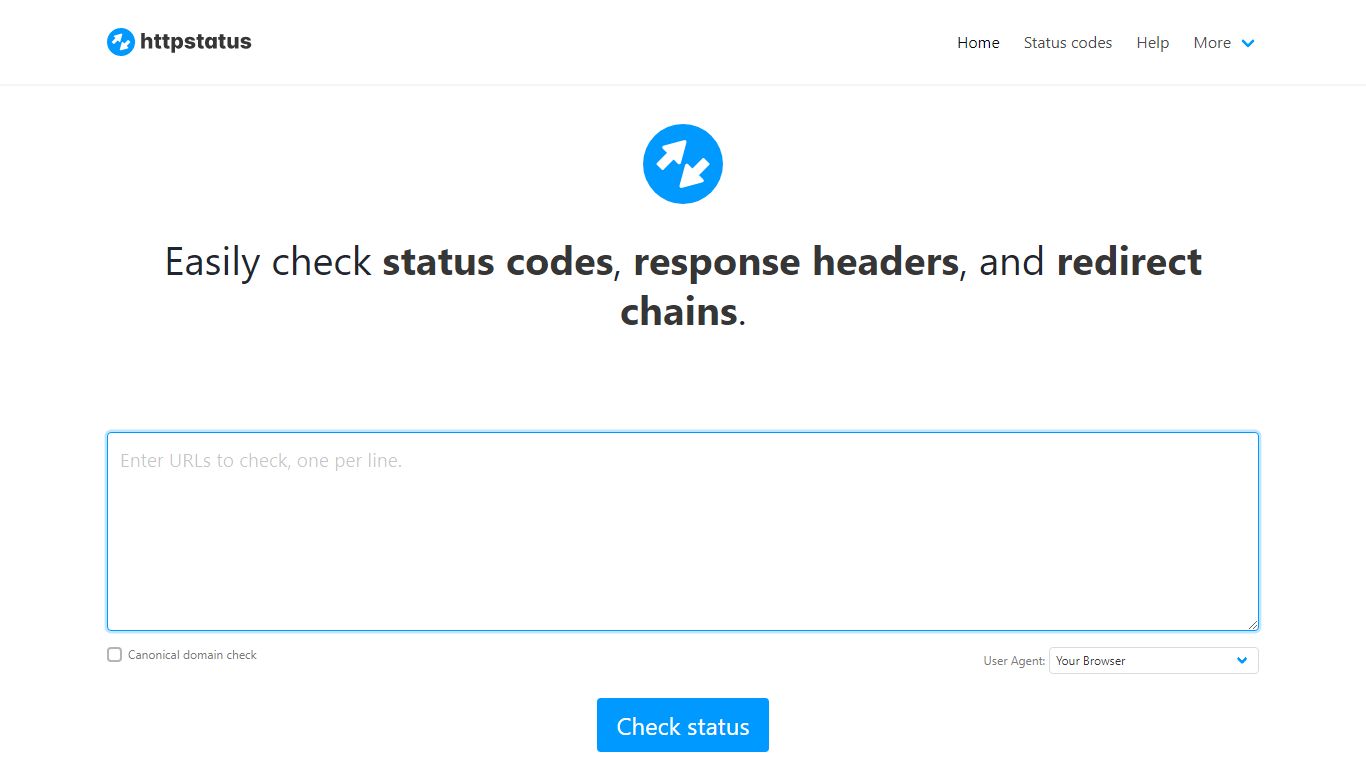
HTTP / HTTPS Header Check – WebConfs.com
WebConfs.com provides a browser‑based tool that fetches the complete set of HTTP response headers returned by a server when a URL is requested. It works with both plain HTTP and encrypted HTTPS URLs, displaying headers such as Strict-Transport-Security, Content-Security-Policy, and X-Frame-Options. The service includes a downloadable PDF that catalogs every standard HTTP status code, from informational 1xx responses to server error 5xx codes, with concise explanations and example use cases. Additionally, WebConfs offers a bookmarklet that can be dragged to a browser’s toolbar; clicking the bookmarklet on any page instantly reveals the page’s header information without leaving the site. This feature is useful for developers who need to verify security directives or caching policies on the fly.
WebConfs HTTP Header Inspection
HTTP / HTTPS Header Check – Detailed Overview
HTTP headers consist of name‑value pairs that convey metadata about a request or response within the Hypertext Transfer Protocol. Common request headers include Host, User-Agent, and Accept, while response headers such as Content-Type, Server, and Set-Cookie inform the client about the nature of the returned content and session management. The tool also lists standard status codes: 100 Continue indicates that the client may proceed with its request body; 101 Switching Protocols signals a protocol upgrade; 102 Processing is used by WebDAV extensions. Successful 2xx codes include 200 OK (standard success) and 201 Created (resource created). Each code is accompanied by a brief description to aid developers in interpreting server behavior.

SSL‑check: Crawl Your HTTPS Website for Insecure Content – Jitbit
Jitbit’s SSL‑check utility performs a recursive crawl of an HTTPS website, following every internal link up to a maximum of 400 pages per domain. During the scan, it identifies any resources—images, JavaScript files, CSS stylesheets—served over an unencrypted http:// URL, which would trigger a mixed‑content warning in browsers like Chrome or Firefox. The report lists each offending page, the exact line number where the insecure reference appears, and provides a suggested replacement URL using HTTPS. By fixing these issues, site owners can prevent browsers from blocking scripts or styles, thereby preserving site functionality and maintaining a fully secure user experience.

SSL Checker – SSL Shopper
SSL Shopper’s checker validates the public SSL/TLS certificate installed on a web server. Users enter the domain name (e.g., example.com); the service then retrieves the certificate chain, verifies that each intermediate certificate is trusted by major root stores, and confirms that the leaf certificate has not expired. The result page displays the certificate’s Common Name, Subject Alternative Names, issuing Certificate Authority, validity period, and the signature algorithm (e.g., SHA‑256 with RSA). It also flags common misconfigurations such as mismatched hostnames, incomplete chains, or unsupported cipher suites, enabling administrators to address problems before they affect visitors.
SSL Shopper Certificate Validator 
SSL Server Test – Powered by Qualys SSL Labs
The Qualys SSL Labs Server Test conducts an in‑depth analysis of a public HTTPS server’s configuration. After entering a domain, the service performs multiple handshake simulations across a range of client platforms, including older browsers and modern TLS 1.3 clients. It evaluates protocol support (SSL v2/v3, TLS 1.0‑1.3), cipher suite preferences, and checks for known vulnerabilities such as Heartbleed, POODLE, and FREAK. Each test results in a letter grade from A+ to F, accompanied by a detailed breakdown of handshake latency, certificate transparency logs, and OCSP stapling status. Results are cached for 24 hours, allowing administrators to compare configuration changes over time.

SSL Checker – Free Online SSL Certificate Test for Your Website – IONOS
IONOS provides a free SSL inspection tool that scans a URL’s TLS configuration for security gaps. The analyzer tests for protocol weaknesses such as POODLE, FREAK, BEAST, CRIME, and the Heartbleed bug, reporting any failures with actionable remediation steps. It also evaluates the server’s support for modern cipher suites, forward secrecy, and the presence of HTTP Strict Transport Security (HSTS) headers. If the certificate fails any of these checks, the tool highlights the specific issue—e.g., an outdated RC4 cipher or a missing HSTS directive—and suggests configuration changes to improve the site’s security posture.

SSL Certificate Checker – Basic Validation
This simple utility prompts users to enter three pieces of information: the hostname (such as mysite.com), the TCP port (default 443 for HTTPS), and optionally a custom port if the server uses a non‑standard configuration. After submitting, the tool attempts a TLS handshake, then displays any errors encountered—expired certificate, hostname mismatch, or untrusted root. It also shows the certificate’s serial number, fingerprint (SHA‑256), and the list of supported protocols (TLS 1.2, TLS 1.3). Users can experiment with different hostnames or ports to diagnose connectivity problems on complex server setups.

SSL Checker – Detailed Certificate Examination
By entering a website address into this tool, visitors trigger a full certificate analysis. The report presents the leaf certificate’s Common Name, all Subject Alternative Names, the issuing Certificate Authority, and the exact validity dates. It also reveals the certificate chain hierarchy, indicating whether each intermediate certificate links back to a trusted root. Additional details include the public key algorithm (RSA 2048, ECDSA 256), the signature hash algorithm, and any extensions such as OCSP stapling or Certificate Transparency logs. The interface clarifies the difference between SSL and TLS, noting that modern browsers only negotiate TLS protocols despite the legacy “SSL” terminology.

Related Search Terms
Limestone Correctional Facility Inmate Search Dauphin County Marriage Records Los Angeles Criminal Records Search Find People Addresses Address Lookup By Phone Hanover County Va Public Records